

In the world of radio, VHF (Very High Frequency) and UHF (Ultra High Frequency) are the most frequently mentioned bands. Many beginners wonder:
When exactly should I use VHF? When should I use UHF?
And how do they differ from HF (High Frequency)?
In practical applications, how should I select radios and antennas?
Online platforms host lively discussions on these topics, featuring insights from professional pilots, military communications personnel, and hands-on experiences shared by amateur radio enthusiasts.
Drawing from these perspectives and real-world scenarios, let's delve deeper into the subject.
1. Frequency Band Division and Fundamental Characteristics
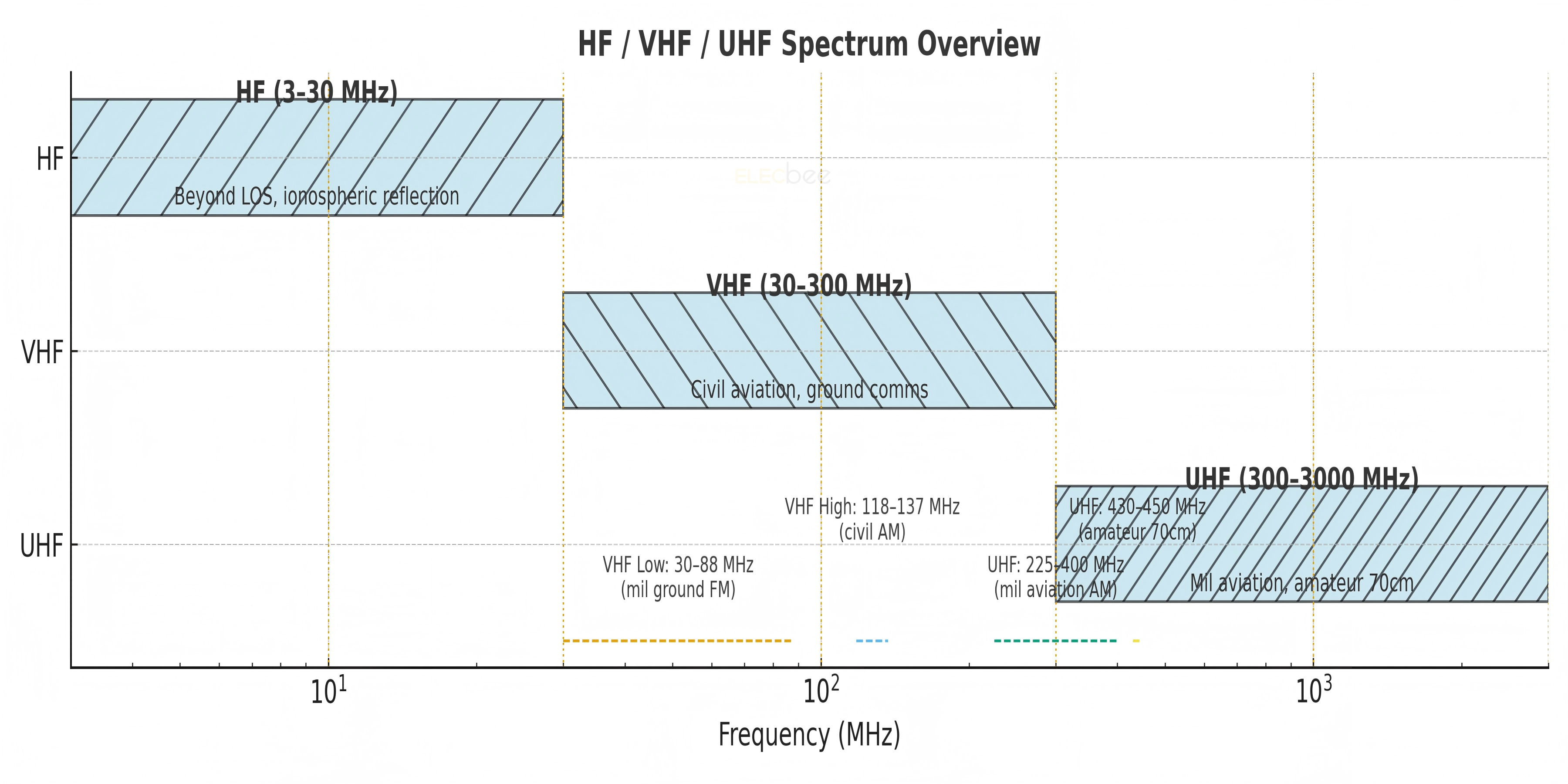
First, let's look at the most straightforward figures:
HF (High Frequency): 3–30 MHz
- Primarily used for long-distance beyond-line-of-sight communication, relying on ionospheric reflection.
VHF (Very High Frequency): 30–300 MHz
- Common sub-bands:
- 30–88 MHz(VHF Low):Military ground communications (mostly FM)
- 118–137 MHz(VHF High):Civil aviation communications (AM)
UHF(Ultra High Frequency):300–3000 MHz
Typical Applications:
- 225–400 MHz:Military aviation (AM)
- 430–450 MHz:Amateur radio (70cm band)
In summary:
- VHF → Longer range, strong penetration
- UHF → Clear audio quality, suitable for urban/line-of-sight conditions
- HF → Over-the-horizon communication, global coverage
2. Differences in Transmission Characteristics and Applications
The prevailing consensus among users is that the frequency band determines the application scenario.
- VHF
- Longer wavelengths enable signals to penetrate forests and valleys, making it suitable for ground combat, wilderness rescue, and mountaineering expeditions.
- Direct line-of-sight performance surpasses UHF in areas without relay stations.
- UHF
- Shorter wavelengths enable transmission closer to optical line-of-sight.
- Ideal for air-to-air communication and urban intercom systems, especially where clear voice transmission is required.
- However, signals are easily obstructed by buildings.
- HF
- Utilizes ionospheric reflection to achieve ultra-long-distance communication that “bends around the curvature of the Earth.”
- A user once successfully contacted the United Kingdom from Canada using a 2MHz HF radio.
- Commonly used in ocean navigation, emergency communications, and amateur “DX operating.”
3. Upgrade Options from Handheld Radios to Mobile/Fixed Stations
For novice amateur radio enthusiasts, upgrading from a handheld transceiver (HT) to a portable or fixed station has always been a hot topic. Many consider expanding a dual-band VHF/UHF handheld into a Pelican case mobile station that combines portable and base station capabilities, while upgrading to HF equipment offers a broader communication experience.
Handheld radios typically offer only 5W of power, while mobile transceivers can deliver up to 50W of output power. When paired with elevated antennas, this power difference significantly enhances communication effectiveness, markedly improving the operating experience. On the other hand, even with just 5W output, HF equipment can achieve long-distance contacts spanning thousands of kilometers using digital modes like FT8 or JS8Call. However, voice modes (SSB) demand higher propagation conditions and antenna matching, which may prove challenging for beginners.
For practical setup, cost-effective entry-level HF options include the Xiegu G90 (20W) and Yaesu FT-891 (100W). Paired with a simple telescopic antenna or an end-fed half-wave antenna, these units enable outdoor activities like Parks on the Air (POTA). Regardless of power level, selecting and positioning the right antenna is crucial for improving communication performance—sometimes even more important than the power output itself.

4. Real-World Comparison: HT vs. Mobile Radio vs. HF
|
Device Type |
Typical Power |
Advantages |
Limitations |
|
HT (Handheld Transceiver) |
5W |
Portable, low cost |
Limited range (1-5 miles) |
|
Mobile Transceiver (V/UHF) |
25–50W |
Expanded coverage, stable relay access |
Still line-of-sight dependent, challenging for ultra-long distances |
|
HF Transceiver |
20–100W |
Ultra-long-distance communication, global DX capability |
Large antenna footprint, higher cost |
A widely circulated analogy among users goes like this:
HTs are like bicycles in walkie-talkies—they just need to get you moving;
V/UHF mobile radios are like motorcycles, offering significantly greater range;
HF radios are like cars, capable of taking you to distant places.

5. Differences Between Civilian and Military Use
Integrating Aviation and Military Communications:
- Civilian Aviation → Primarily uses the VHF band (118–137 MHz, AM).
- Military aviation → Commonly uses UHF (225–400 MHz), with many bases employing dual-frequency broadcasting to ensure compatibility across different aircraft types.
- Ground forces → Primarily utilize the VHF low-frequency band (30–88 MHz, FM) due to its superior resistance to terrain attenuation.
Summary:
UHF is predominantly used for airborne communications, VHF for ground-based communications, while HF represents the true “strategic communications.”

6. Choices for Amateur Radio Operators
For amateur radio enthusiasts, equipment selection primarily depends on communication objectives:
- For primarily urban communication or local community activities, a VHF/UHF dual-band handheld or mobile radio will suffice.
- For cross-provincial or even international communications, an HF radio is the essential core equipment.
- For flexibility and portability, consider a hybrid setup: a portable VHF/UHF handheld for local contacts, paired with an HF QRP radio for long-distance communication attempts.
- This configuration ensures the convenience of local communication while also allowing you to enjoy the thrill of long-distance radio contact.

7. The Joy of HF: Not Just Distance, But Versatile Playstyles
The appeal of HF (High Frequency) radios lies in:
- Diverse Modes:Supports CW (Morse code), SSB (voice), FT8/JS8Call (digital modes), and more, catering to the interests of different enthusiasts.
- Global Reach:HF signals propagate via the ionosphere, enabling connections with enthusiasts thousands of kilometers away and delivering the thrill of transcontinental communication.
- Challenge and Accomplishment:Achieving long-distance contacts under low-power (QRP) conditions tests technical skills while delivering a profound sense of accomplishment.
For beginners, starting with low power and simple antennas when trying HF allows you to gradually learn different modes and bands. Choosing high-quality connectors (such as UHF connectors) and reliable antennas helps achieve stable signals and a better communication experience.

8. Equipment Integration and Modern Applications
In practical applications, many modern devices already support multi-frequency integration.
For example, the Raymarine AXIOM 9 Pro RVX, while primarily a marine navigation and sonar imaging system, seamlessly integrates with VHF communication equipment to provide a complete navigation and communication solution for ocean voyages.
The advantages of such platforms include:
- Reduced device switching for simpler operation
- Enhanced navigation safety, particularly during communication loss or emergencies
- Multifunctional integration, consolidating communication, navigation, and monitoring on a single screen

9. How Should Beginners Choose VHF/UHF/HF Connectors?
In the construction of radio systems, connectors are equally indispensable core components alongside radios and antennas. Radios operating in different frequency bands (HF, VHF, UHF) often utilize distinct interfaces. Improper selection may result in significant signal loss, elevated standing wave ratio (SWR), or even prevent devices from connecting altogether.
Common Connector Types:
- HF Common Connectors:
- Most commonly PL-259 (UHF male) / SO-239 (UHF female), as HF has low bandwidth requirements and UHF connectors adequately meet these needs.
- VHF/UHF Common Connectors:
- UHF connectors (PL-259/SO-239):The oldest and most common amateur radio interface, supported by nearly all entry-level VHF/UHF equipment.
- N Type connectors:Suitable for higher frequencies and outdoor high-power applications, offering superior waterproofing and corrosion resistance.
- BNC connectors:Primarily used in portable radios and test equipment for easy installation and removal.
Why are UHF connectors recommended for beginners?
- Excellent compatibility → Most HF, VHF, and UHF amateur radios and antennas use UHF connectors by default.
- High cost-effectiveness → Simple construction and low cost, yet provides stable RF connections.
- Easy to expand → From HF to UHF, most equipment can directly use UHF connectors without additional adapters.
Therefore, for beginners, UHF connectors are the most suitable entry-level choice.
Elecbee offers a variety of UHF connectors (threaded, quick-connect, waterproof) to meet diverse application scenarios such as home base stations, mobile radios, and outdoor antennas.
Tip: Unstable signal quality often stems not from insufficient radio power, but from using low-quality or mismatched connectors. Choosing high-quality UHF connectors can make your radio system perform twice as well with half the effort.
|
Frequency Band |
Common Connector Types |
Applications |
|
HF (3–30 MHz) |
PL-259 / SO-239 |
Amateur radio stations, long-distance DX communications, shortwave broadcast reception |
|
VHF (30–300 MHz) |
BNC、UHF(PL-259/SO-239)、SMA |
Amateur walkie-talkies, radio base stations, maritime communications |
|
UHF (300 MHz–3 GHz) |
UHF(PL-259/SO-239)、SMA、N Type |
Radio stations, wireless microphones, wireless networks, professional communications |
10. Summary and Recommendations
Based on practical applications, the suitable scenarios for different frequency bands are as follows :
- VHF: Suitable for ground communications, forest areas, hiking, and general infantry use, offering stable signal coverage and moderate transmission range.
- UHF: Ideal for urban environments, air-to-air communications, and air traffic control scenarios, featuring strong signal penetration and clear voice transmission.
- HF: Designed for ultra-long-range communications, intercontinental/oceanic connections, and emergency communications, enabling remote communication links.
When selecting equipment, remember this simple rule of thumb: “VHF travels far, UHF sounds clear, HF spreads wide.”
For Amateur Radio Operators:
- Beginner:Experience basic communications using handheld transceivers (HT) and repeaters.
- Intermediate:Equip mobile transceivers (VHF/UHF 50W) to extend coverage range.
- Expert:Experience the thrill of transcontinental DX communications with HF radios (20W+).
In specialized applications such as maritime navigation, aviation, and military operations, the emergence of multifunctional systems has made the integration of communications and navigation more efficient and convenient.
The world of radio is a game of endless exploration into frequencies and propagation. From local urban communications to signals leaping across oceans, each band holds its own value. The true joy lies in selecting the right tool for different scenarios and savoring the sense of accomplishment as sound waves traverse time and space.